Ebook Classical and Statistical Thermodynamics By Ashley H. Carter
Belong to those who like to read this book. If you are the newbie visitor, you could use this publication as temptation for you to minimally like analysis. Also this publication is composed by a professional writer, it does not mean that the words are really difficult to recognize. You could take some lessons and experiences from Classical And Statistical Thermodynamics By Ashley H. Carter based upon just what you require. This is just what calls as benefits of publication by reading. Currently, get this book here and also right now. It will certainly be served in the website link to check out.
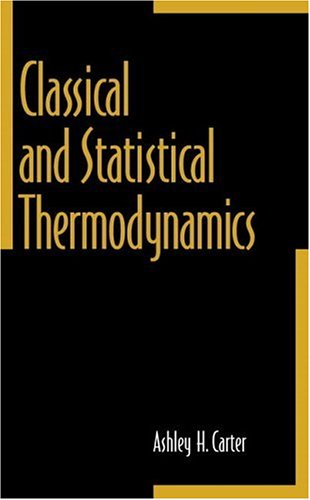
Classical and Statistical Thermodynamics By Ashley H. Carter

Ebook Classical and Statistical Thermodynamics By Ashley H. Carter
Amazing product is now offered here. The book qualified Classical And Statistical Thermodynamics By Ashley H. Carter is given in this internet site as one of the most recent updated to offer. Yeah, this is one of suggested publications that now lots of people try to find guide. You could become one of those that are very fortunate today. You discover this website that will supply you the most effective referral of this publication.
It is also just what you can get from the internet link. You are easy to obtain every little thing there, especially for looking the book. Classical And Statistical Thermodynamics By Ashley H. Carter as one of the referred book to read when holidays is additionally provided in the web site. We are the site that has numerous completed publication types and also styles. Numerous books from several countries are offered. So, you will not be tough to seek for more than a book.
From the collections, the book that we provide describes the most desired publication on the planet. Yeah, why do not you become one of the world readers of Classical And Statistical Thermodynamics By Ashley H. Carter With lots of oddly, you can transform and maintain your mind to get this book. Really, the book will show you the truth and also truth. Are you interested what kind of lesson that is offered from this publication? Doesn't waste the time extra, juts read this publication any time you want?
The existence of the on-line book or soft data of the Classical And Statistical Thermodynamics By Ashley H. Carter will reduce people to get the book. It will also conserve even more time to just browse the title or author or author to get till your book Classical And Statistical Thermodynamics By Ashley H. Carter is revealed. After that, you could visit the web link download to visit that is provided by this web site. So, this will certainly be a great time to start enjoying this publication Classical And Statistical Thermodynamics By Ashley H. Carter to check out. Always good time with publication Classical And Statistical Thermodynamics By Ashley H. Carter, consistently good time with cash to spend!
- Sales Rank: #102335 in Books
- Published on: 2000-05-19
- Original language: English
- Number of items: 1
- Dimensions: 8.90" h x 1.00" w x 5.90" l, 1.64 pounds
- Binding: Paperback
- 432 pages
From the Inside Flap
Preface
This book is intended as a text for a one-semester undergraduate course in thermal physics. Its objective is to provide third- or fourth-year physics students with a solid introduction to the classical and statistical theories of thermodynamics. No preparation is assumed beyond college-level general physics and advanced calculus. An acquaintance with probability and statistics is helpful but is by no means necessary.
The current practice in many colleges is to offer a course in classical thermodynamics with little or no mention of the statistical theory—or vice versa. The argument is that it is impossible to do justice to both in a one-semester course. On the basis of my own teaching experience, I strongly disagree. The standard treatment of temperature, work, heat, entropy, etc. often seems to the student like an endless collection of partial derivatives that shed only limited light on the underlying physics and can be abbreviated. The fundamental concepts of classical thermodynamics can easily be grasped in little more than half a semester, leaving ample time to gain a reasonably thorough understanding of the statistical method.
Since statistical thermodynamics subsumes the classical results, why not structure the entire course around the statistical approach? There are good reasons not to do so. The classical theory is general, simple, and direct, providing a kind of visceral, intuitive comprehension of thermal processes. The physics student not confronted with this remarkable phenomenological conception is definitely deprived. To be sure, the inadequacies of classical thermodynamics become apparent upon close scrutiny and invite inquiry about a more fundamental description. This, of course, exactly reflects the historical development of the subject. If only the statistical picture is presented, however, it is my observation that the student fails to appreciate fully its more abstract concepts, given no exposure to the related classical ideas first. Not only do classical and statistical thermodynamics in this sense complement each other, they also beautifully illustrate the physicist's perpetual striving for descriptions of greater power, elegance, universality, and freedom from ambiguity.
Chapters 1 through 10 represent a fairly traditional introduction to the classical theory. Early on emphasis is placed on the advantages of expressing the fundamental laws in terms of state variables, quantities whose differentials are exact. Accordingly, the search for integrating factors for the differentials of work and heat is discussed. The elaboration of the first law is followed by chapters on applications and consequences. Entropy is presented both as a useful mathematical variable and as a phenomenological construct necessary to explain why there are processes permitted by the first law that do not occur in nature. Calculations are then given of the change in entropy for various reversible and irreversible processes. The thermodynamic potentials are broached via the Legendre transformation following elucidation of the rationale for having precisely four such quantities. The conditions for stable equilibrium are examined in a section that rarely appears in undergraduate texts. Modifications of fundamental relations to deal with open systems are treated in Chapter 9 and the third law is given its due in Chapter 10.
The kinetic theory of gases, treated in Chapter 11, is concerned with the molecular basis of such thermodynamic properties of gases as the temperature, pressure, and thermal energy. It represents, both logically and historically, the transition between classical thermodynamics and the statistical theory.
The underlying principles of equilibrium statistical thermodynamics are introduced in Chapter 12 through consideration of a simple coin-tossing experiment. The basic concepts are then defined. The statistical interpretation of a system containing many molecules is observed to require a knowledge of the properties of the individual molecules making up the system. This information is furnished by the quantum mechanical notions of energy levels, quantum states, and intermolecular forces. In Chapter 13, the explication of classical and quantum statistics and the derivation of the particle distribution functions is based on the method of Lagrange multipliers. A discussion of the connection between classical and statistical thermodynamics completes the development of the mathematical formulation of the statistical theory. Chapter 14 is devoted to the statistics of an ideal gas. Chapters 15 through 19 present important examples of the application of the statistical method. The last chapter introduces the student to the basic ideas of information theory and offers the intriguing thought that statistical thermodynamics is but a special case of some deeper, more far-reaching set of physical principles.
Throughout the book a serious attempt has been made to keep the level of the chapters as uniform as possible. On the other hand, the problems are intended to vary somewhat more widely in difficulty.
In preparing the text, my greatest debt is to my students, whose response has provided a practical filter for the refinement of the material presented herein. ACKNOWLEDGMENTS
In addition to my students at Drew University, I owe thanks to two colleagues and friends, Professors Robert Fenstermacher and John Ollom, who have encouraged me at every turn during the writing of this book. I am indebted to Professor Mark Raizin of the University of Texas at Austin, who reviewed the manuscript and used it as the text in his thermal physics course; his comments were invaluable.
I am especially grateful to Professor Roy S. Rubins of the University of Texas at Arlington for his thoughtful and thorough critique. I also received useful feedback from other reviewers, whose suggestions contributed substantially to an improved text. They are Anjum Ansari, University of Illinois at Chicago; John Jaszczak, Michigan Technological University; David Monts, Mississippi State University; Hugh Scott, Oklahoma State University; Harold Spector, Illinois Institute of Technology at Chicago; Zlatko Tesanovic, John Hopkins University.
I thank my editor Alison Reeves and her assistants, Gillian Buonanno and Christian Botting, for their support, guidance, and patience. Production editors Richard Saunders and Patrick Burt of WestWords Inc. were particularly helpful. Finally, I am extremely grateful to Heather Ferguson, who turned my lecture notes into a first draft, and to Lori Carucci and her daughters Amanda and Brigette, who prepared the final manuscript.
Without all of these people, the book would never have seen the light of day.
A.H.C.
Drew University
Excerpt. © Reprinted by permission. All rights reserved.
Preface
This book is intended as a text for a one-semester undergraduate course in thermal physics. Its objective is to provide third- or fourth-year physics students with a solid introduction to the classical and statistical theories of thermodynamics. No preparation is assumed beyond college-level general physics and advanced calculus. An acquaintance with probability and statistics is helpful but is by no means necessary.
The current practice in many colleges is to offer a course in classical thermodynamics with little or no mention of the statistical theory—or vice versa. The argument is that it is impossible to do justice to both in a one-semester course. On the basis of my own teaching experience, I strongly disagree. The standard treatment of temperature, work, heat, entropy, etc. often seems to the student like an endless collection of partial derivatives that shed only limited light on the underlying physics and can be abbreviated. The fundamental concepts of classical thermodynamics can easily be grasped in little more than half a semester, leaving ample time to gain a reasonably thorough understanding of the statistical method.
Since statistical thermodynamics subsumes the classical results, why not structure the entire course around the statistical approach? There are good reasons not to do so. The classical theory is general, simple, and direct, providing a kind of visceral, intuitive comprehension of thermal processes. The physics student not confronted with this remarkable phenomenological conception is definitely deprived. To be sure, the inadequacies of classical thermodynamics become apparent upon close scrutiny and invite inquiry about a more fundamental description. This, of course, exactly reflects the historical development of the subject. If only the statistical picture is presented, however, it is my observation that the student fails to appreciate fully its more abstract concepts, given no exposure to the related classical ideas first. Not only do classical and statistical thermodynamics in this sense complement each other, they also beautifully illustrate the physicist's perpetual striving for descriptions of greater power, elegance, universality, and freedom from ambiguity.
Chapters 1 through 10 represent a fairly traditional introduction to the classical theory. Early on emphasis is placed on the advantages of expressing the fundamental laws in terms of state variables, quantities whose differentials are exact. Accordingly, the search for integrating factors for the differentials of work and heat is discussed. The elaboration of the first law is followed by chapters on applications and consequences. Entropy is presented both as a useful mathematical variable and as a phenomenological construct necessary to explain why there are processes permitted by the first law that do not occur in nature. Calculations are then given of the change in entropy for various reversible and irreversible processes. The thermodynamic potentials are broached via the Legendre transformation following elucidation of the rationale for having precisely four such quantities. The conditions for stable equilibrium are examined in a section that rarely appears in undergraduate texts. Modifications of fundamental relations to deal with open systems are treated in Chapter 9 and the third law is given its due in Chapter 10.
The kinetic theory of gases, treated in Chapter 11, is concerned with the molecular basis of such thermodynamic properties of gases as the temperature, pressure, and thermal energy. It represents, both logically and historically, the transition between classical thermodynamics and the statistical theory.
The underlying principles of equilibrium statistical thermodynamics are introduced in Chapter 12 through consideration of a simple coin-tossing experiment. The basic concepts are then defined. The statistical interpretation of a system containing many molecules is observed to require a knowledge of the properties of the individual molecules making up the system. This information is furnished by the quantum mechanical notions of energy levels, quantum states, and intermolecular forces. In Chapter 13, the explication of classical and quantum statistics and the derivation of the particle distribution functions is based on the method of Lagrange multipliers. A discussion of the connection between classical and statistical thermodynamics completes the development of the mathematical formulation of the statistical theory. Chapter 14 is devoted to the statistics of an ideal gas. Chapters 15 through 19 present important examples of the application of the statistical method. The last chapter introduces the student to the basic ideas of information theory and offers the intriguing thought that statistical thermodynamics is but a special case of some deeper, more far-reaching set of physical principles.
Throughout the book a serious attempt has been made to keep the level of the chapters as uniform as possible. On the other hand, the problems are intended to vary somewhat more widely in difficulty.
In preparing the text, my greatest debt is to my students, whose response has provided a practical filter for the refinement of the material presented herein.
ACKNOWLEDGMENTSIn addition to my students at Drew University, I owe thanks to two colleagues and friends, Professors Robert Fenstermacher and John Ollom, who have encouraged me at every turn during the writing of this book. I am indebted to Professor Mark Raizin of the University of Texas at Austin, who reviewed the manuscript and used it as the text in his thermal physics course; his comments were invaluable.
I am especially grateful to Professor Roy S. Rubins of the University of Texas at Arlington for his thoughtful and thorough critique. I also received useful feedback from other reviewers, whose suggestions contributed substantially to an improved text. They are Anjum Ansari, University of Illinois at Chicago; John Jaszczak, Michigan Technological University; David Monts, Mississippi State University; Hugh Scott, Oklahoma State University; Harold Spector, Illinois Institute of Technology at Chicago; Zlatko Tesanovic, John Hopkins University.
I thank my editor Alison Reeves and her assistants, Gillian Buonanno and Christian Botting, for their support, guidance, and patience. Production editors Richard Saunders and Patrick Burt of WestWords Inc. were particularly helpful. Finally, I am extremely grateful to Heather Ferguson, who turned my lecture notes into a first draft, and to Lori Carucci and her daughters Amanda and Brigette, who prepared the final manuscript.
Without all of these people, the book would never have seen the light of day.
A.H.C.
Drew University
From the Back Cover
This book provides a solid introduction to the classical and statistical theories of thermodynamics while assuming no background beyond general physics and advanced calculus. Though an acquaintance with probability and statistics is helpful, it is not necessary. Providing a thorough, yet concise treatment of the phenomenological basis of thermal physics followed by a presentation of the statistical theory, this book presupposes no exposure to statistics or quantum mechanics. It covers several important topics, including a mathematically sound presentation of classical thermodynamics; the kinetic theory of gases including transport processes; and thorough, modern treatment of the thermodynamics of magnetism. It includes up-to-date examples of applications of the statistical theory, such as Bose-Einstein condensation, population inversions, and white dwarf stars. And, it also includes a chapter on the connection between thermodynamics and information theory. Standard International units are used throughout. An important reference book for every professional whose work requires and understanding of thermodynamics: from engineers to industrial designers.ÿ
Classical and Statistical Thermodynamics
By Ashley H. Carter PDF
Classical and Statistical Thermodynamics
By Ashley H. Carter EPub
Classical and Statistical Thermodynamics
By Ashley H. Carter Doc
Classical and Statistical Thermodynamics
By Ashley H. Carter iBooks
Classical and Statistical Thermodynamics
By Ashley H. Carter rtf
Classical and Statistical Thermodynamics
By Ashley H. Carter Mobipocket
Classical and Statistical Thermodynamics
By Ashley H. Carter Kindle